



Why legacy ERP systems hold entire companies hostage
An outdated ERP system is today the most common reason why mid-sized companies fail to make the leap to becoming an AI-native business. Not the budget, not the people, not a lack of will. But a piece of software in the engine room that nobody has been allowed to touch for years. It cements data silos, blocks modern interfaces and prevents exactly the open data standards that every AI strategy depends on. Over the past months I have discussed this with dozens of business owners – and the pattern repeats itself alarmingly often.
I am writing this post because I believe many managing directors can feel the problem but cannot name it. They know that "something about the IT" is slowing them down. What they don't know is that they have long since become hostages of their own core system.
The conversation I keep having
A few weeks ago I sat down with a manufacturing entrepreneur – healthy mid-sized company, three-digit headcount, profitable. He wanted to talk about AI agents and automation in order processing. A good idea. After twenty minutes came the sentence I can now predict almost word for word:
"The problem is our ERP. We can't get at it."
In the engine room ran an MS SQL database on a 2012 level. Grown over a decade, customised by an external provider who barely supports the system any more. Every query beyond standard reporting becomes a project. Connecting modern tools? "Better not, or production goes down." That is not the exception. It is the normal case I encounter week after week.
What does it mean to be held hostage by an ERP system?
Being held hostage by an ERP system means that an outdated core system dictates a company's room for manoeuvre instead of expanding it. Every strategic decision – new software, new processes, AI projects – must submit to the question: "Does our ERP even allow that?" The company no longer makes decisions freely; it negotiates with its own legacy.
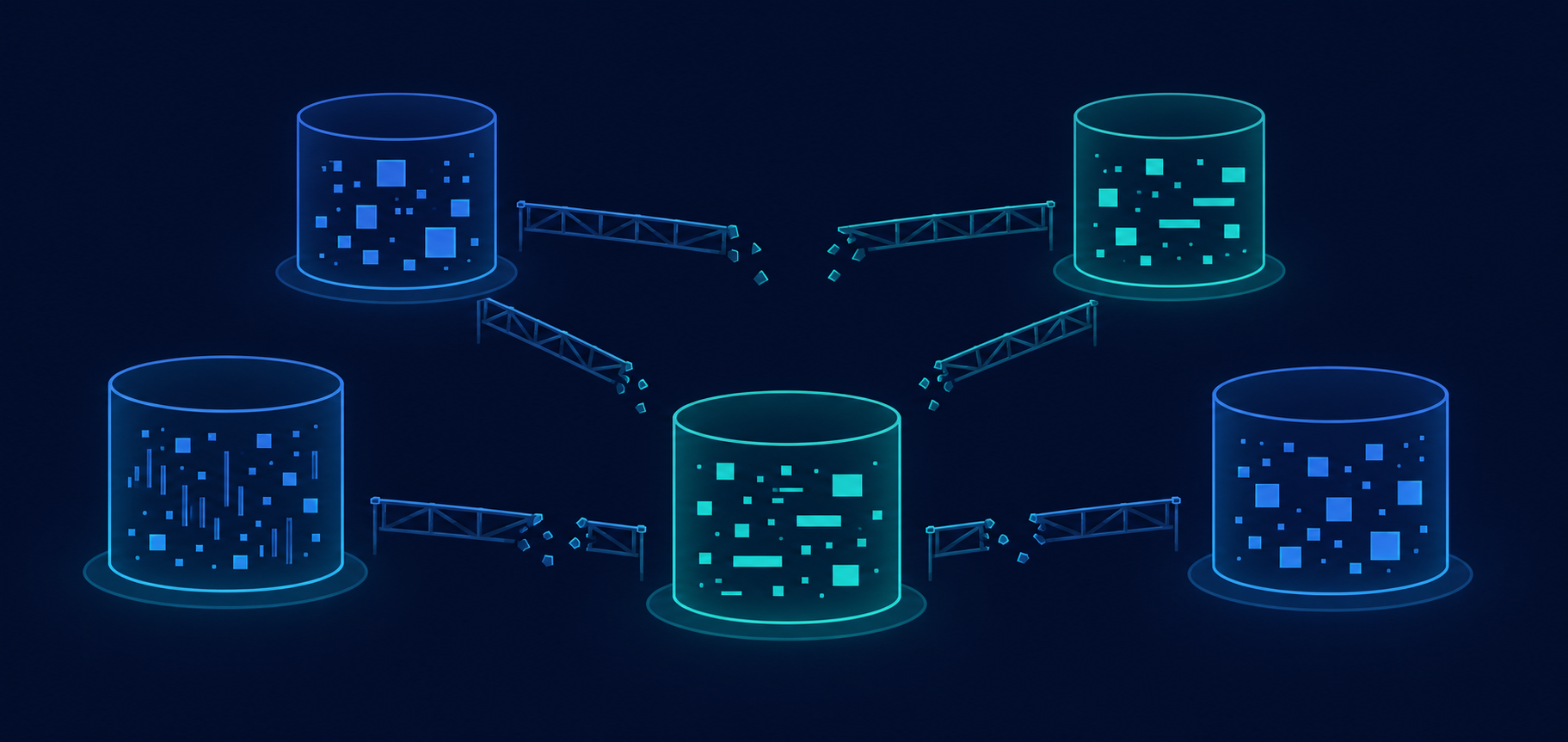
The hostage-takers are not malicious. They are technical realities:
- Outdated database versions such as MS SQL Server 2012 that no longer support modern security and communication standards.
- Monolithic architectures where a change in one place triggers incalculable side effects elsewhere.
- Missing or proprietary interfaces that only allow connections to third-party systems with high manual effort.
- Dependence on individual service providers who are the only ones who still understand the historically grown system.
Why are legacy ERP systems so hard to connect?
Legacy ERP systems are hard to connect because they date back to an era in which data was supposed to stay inside the system – not flow out of it. An MS SQL Server 2012, for example, simply doesn't know many of today's standard mechanisms, or supports them only partially: modern authentication, secure encryption protocols, change data capture in the form modern pipelines expect, or a clean API layer.
The result is a double problem. First, queries can only be realised to a limited extent: anything not foreseen in the rigid reporting has to be rebuilt at great expense – often with the fear of destabilising the production environment. Second, modern middleware and data integration services cannot unfold their potential.
A concrete example: Airbyte as a middleware service is designed to move data from source systems into a modern data warehouse or AI stack via standardised connectors. But a connector is only as good as the interface it docks onto. If the legacy system doesn't speak modern communication standards – no clean API, no reliable logs for change data capture, no up-to-date authentication – then even the best tool runs into a void. The bridge is built, but the other shore is missing.
This creates the paradoxical situation of companies investing in modern data tools and still not making progress. Not because the tools are bad – but because the foundation cannot carry them.
The real damage: data silos instead of open data standards
The biggest damage caused by legacy ERP systems is not slow performance or expensive support. It is that they reinforce data silos instead of establishing open data standards. Every time a department fails at the ERP hurdle, it builds itself an emergency exit: an Excel list here, a small island solution there, a manually maintained database in sales. This is the birth of shadow IT.
Data that should belong to the whole company ends up scattered across dozens of disconnected islands. The consequences are real and expensive:
| Symptom | Concrete impact in daily work |
|---|---|
| Duplicate data storage | Customer address in the ERP, in the CRM and in three Excel lists – none of them fully correct. |
| Manual transfers | Employees retype numbers from one system into the next. Error-prone and expensive. |
| No single source of truth | Two departments, two truths. Meetings revolve around "whose number is right?" |
| Growing technical debt | Every workaround makes the next modernisation project more expensive. |
An open data standard would achieve the opposite: data would be captured cleanly once and made available to all authorised systems via clear interfaces. The outdated ERP pulls in the opposite direction – it makes data access the exception instead of the rule.
Why this permanently blocks the path to the AI-native business
An AI-native business is a company whose processes, decisions and products are designed by default around machine intelligence and freely flowing data. AI is not an add-on there; it is the base assumption. And this is exactly the crucial point: AI needs data – accessible, current, in context.
An AI agent that is supposed to create quotes, forecast inventory or answer customer enquiries is only as smart as the data it can access. If that data is locked inside a 2012-era ERP, behind rigid queries and without a modern interface, the AI sees nothing. That is the core of the problem:
- No data access = no AI. Language models and agents need context. A sealed-off ERP doesn't deliver it.
- Silos prevent the big picture. AI unfolds its value across departmental boundaries. Exactly those are torn apart again by the old ERP.
- Outdated standards throttle real time. Modern AI applications are event-driven. Batch exports from a legacy system are the opposite.
A technical detail thus becomes a strategic dead end. While competitors streamline their processes with AI, the captive company keeps managing its workarounds. The gap grows – quietly, but steadily.
How do you free a company from ERP hostage?
A company frees itself from ERP hostage not through a risky big-bang replacement, but through step-by-step decoupling: you place a modern data layer on top of the legacy system, liberate the data piece by piece, and turn the ERP from a brake into a mere supplier. In practice, this path has proven itself:
- Inventory & data audit. Which data lives where? Which silos already exist? Where are the most expensive manual bridges? Without this map, every project is a blind flight.
- Introduce an integration and abstraction layer. Instead of drilling directly into the legacy system, you build a modern API or middleware layer in front of it. It translates between the old world and modern standards – and makes tools like Airbyte effective in the first place.
- Establish open data standards. A central, accessible data model becomes the new single source of truth. Silos are docked on step by step instead of multiplying further.
- Replace gradually (strangler pattern). Function by function is extracted from the monolith and replaced with modern, AI-ready building blocks. The risk remains controllable at all times.
- Put AI on the liberated foundation. Only once the data flows does the real leverage begin: agents, automation and forecasts on a clean, open basis.
The decisive thought: you don't have to replace the ERP overnight. You have to strip it of its power – take away its role as gatekeeper and demote it to one of many data suppliers attached to an open architecture.
Frequently asked questions about legacy ERP systems and AI
How do I recognise that our ERP system is slowing us down?
Typical warning signs: reports take days instead of minutes, new software can only be connected via manual exports, Excel island solutions multiply, and your provider urges caution with every change "because of the legacy system". If your IT decisions start with "is that even possible?" instead of "do we want that?", you are already being held hostage.
Do I have to replace my old ERP completely to use AI?
No. In most cases a complete replacement is neither necessary nor advisable. A modern integration layer that connects the legacy system and makes the data accessible is more sensible. The ERP is decoupled step by step without endangering ongoing operations.
Why doesn't Airbyte simply work with my old ERP?
Airbyte and similar middleware services need modern interfaces – a clean API, reliable change data capture mechanisms and up-to-date authentication. Legacy systems such as an MS SQL Server 2012 often don't support these standards, or only partially. An upstream abstraction layer closes this gap and makes modern data integration possible in the first place.
What does it cost to remain in ERP hostage?
The direct costs – support, maintenance, manual work – are only the tip. The real price is the missed opportunities: every process chain not automated, every AI application that fails at data access, every competitive lead that more agile competitors build. These opportunity costs grow with every month.
Conclusion: free your data before you talk about AI
The entrepreneurs I talk to are not technology refuseniks. They are ambitious and want to use the possibilities of AI. But they sit on a foundation that holds them back. An outdated ERP system is not a pure IT topic – it is a strategic shackle that cements data silos and blocks the path to the AI-native business.
The good news: the way out of hostage is plannable. It doesn't start with the most expensive AI tool, but with an honest inventory and an architecture that liberates data instead of locking it up. For those who lay this foundation, AI turns from a distant promise into the next logical step.
Are you sitting on a legacy system that slows you down? In a free ERP audit by PixelMechanics we look together at where your data is trapped, which silos cause the greatest damage and what a realistic path to an AI-ready architecture looks like – without big-bang risk. Book your no-obligation initial consultation now.
About the author: Michael Rohrmüller is the founder of PixelMechanics and accompanies mid-sized companies on their way to the AI-native organisation – from liberation from legacy systems and modern data architectures to the productive use of AI agents.