Odoo implementation: your ERP productive in 6 to 8 weeks
As an Odoo Ready Partner we implement Odoo – with a fixed-price entry point, data migration without losses, and a go-live in stages instead of a big bang.
Book a free initial consultation
Odoo Ready Partner – and practitioners ourselves
We are an official member of the Odoo partner network and work on the current Odoo version. Just as important: we run our own company on Odoo – CRM, projects, invoicing, time tracking. Every recommendation we make, we have already lived with ourselves.
When an ERP implementation is due
Rarely because somebody wanted new software. Usually because the old setup has quietly stopped carrying the company. These are the triggers we see most often:
- Excel has become a system. Prices, stock, planning – each in its own file, each with its own owner, none of them connected.
- Lexware or a comparable package is at its limit. It still does accounting, but not the business around it.
- An SAP R/3 without maintenance. It runs, but nobody dares to touch it and nobody supports it any more.
- The company has grown past its system. What worked with 20 people breaks at 60.
- The same data is entered twice. Once in the merchandise management system, once in accounting – and the two never quite agree.
If you recognise two or more of these, the question is no longer whether, but in which order.
How your Odoo implementation runs
Five stages. Each one ends with a result you can look at and decide on – not with a status report.
2 weeks · fixed price
ERP readiness check
Process capture, module selection, and a dependable frame for effort and cost. You get a written assessment and a recommendation. If Odoo is not the right fit, you hear that from us too.
2 to 4 weeks
Process design
We map your workflows onto the Odoo standard – and decide deliberately against custom development wherever the standard carries. Every deviation is written down, including the reason.
Runs in parallel
Data migration with integrity
Master data, open items, history. Always a test run before the real one, and a reconciliation you can check. Cleaning up happens before the import, not after.
Module by module
Go-live in stages
No cut-over date on which everything has to work at once. We go live area by area, so an error stays an error and does not become a standstill.
Ongoing
Operation, support and further development
Agreed response times, a plan for the yearly Odoo release, and a system that stays upgradeable. What comes next – mobile apps, AI in day-to-day business – builds on the same foundation.
What Odoo looks like in daily work
No grey input masks. Odoo shows processes as tiles you can move: every card is an order, a lead, a production step. Your team sees the status of an area at a glance instead of reading it out of a list.
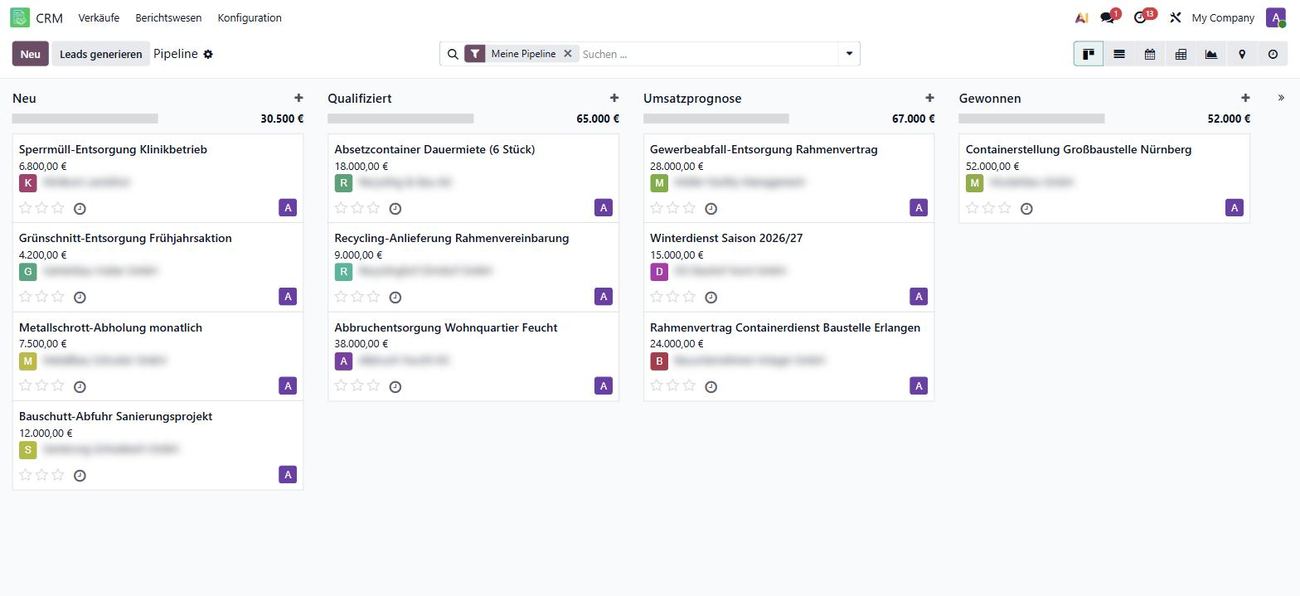
What the implementation costs
Two different things are often mixed up here: the licence and the implementation. The licence is a fixed amount per user per month and includes access to all standard Odoo apps – you do not buy modules individually. The implementation is a one-off project: process design, configuration, data migration, training.
Running afterwards are the licence and, if you want it, support and further development. One-off is the project. We name both separately in every offer, so you can see what is a one-time cost and what you carry every year.
PLACEHOLDER – price range for the ERP readiness check to be inserted here before publication.
Migration from your legacy system
SAP R/3, Lexware, Sage, Excel – we have moved all of them. The promise is simple: nothing gets lost. What comes along is master data, open items and as much history as is genuinely useful. What stays behind goes into a readable archive, not into the bin.
Every migration runs at least once as a test before it runs for real. You check the result against your old system before we switch anything over.
Why PixelMechanics for your Odoo implementation
Odoo Ready Partner
Official member of the Odoo partner network, working on the current Odoo version – not on a release we froze three years ago.
We build on Odoo ourselves
Circuflow and ProcessFlow are our own products on an Odoo foundation. That is the difference between a partner who resells and one who lives in the system every day.
Owner-managed since 2008
In Nuremberg, with the same people in the projects who sold them. No handover to a team you have never met.
Built for the DACH region
SKR03 and SKR04, DATEV export, GoBD-compliant bookkeeping. Your tax advisor keeps working the way they are used to.
You choose the operating model
Odoo Online, Odoo.sh or on-premise in your own data centre. In every case GDPR-compliant and hosted in the EU.
No dead ends
Standard before code, documented handover, your data exportable at any time. If you ever want to continue without us, you can.
Related on this site
Book a free initial consultation
In a free 30-minute conversation we clarify which modules you need and what the implementation costs. On working days you will usually hear back from us within 2 hours.
Frequently asked questions about the Odoo implementation
How long does an Odoo implementation take?
Six to eight weeks for a standard scope with CRM, sales and purchasing. Three to six months when manufacturing, multi-company or interfaces to other systems are involved. What stretches a project is almost never the software, it is unresolved decisions.
What does an Odoo implementation cost?
Licence and implementation are two separate items. The licence is a fixed amount per user per month and covers all standard apps. The implementation is a one-off project whose size depends on scope and data quality. The readiness check has a fixed price and gives you a dependable estimate before you commit to anything.
Can you migrate our data from SAP, Lexware or Excel?
Yes. Master data, open items and history as far as it is useful. Every migration runs as a test first, and you check the result against your old system before we switch anything over.
How much custom development makes sense?
As little as possible. Every deviation from the standard has to be justified and gets written down with its reason. The test we apply to a special case: is this a competitive advantage or an old habit? Only the first kind gets built.
Odoo or SAP Business One or Business Central?
Odoo usually plays to its strengths where breadth matters more than depth in a single discipline: one system for sales, purchasing, inventory, projects and accounting, with a licence that does not charge per module. Where a highly specialised industry standard already fits, we will say so. That is part of the readiness check.
What happens after the go-live?
We stay close in the first weeks and fix what real operation brings to light. Afterwards you decide: continue on your own with documented handover, or with an agreed support model including response times.
How do Odoo upgrades work?
Odoo publishes a new major version every year. We build so that you can follow along: standard before code, every deviation tested against the next version. Upgrades are planned, not improvised – that is the difference between a system you keep current and one you freeze.
Do we have to move everything at once?
No. We go live module by module instead of on a single cut-over date. That keeps every problem small and lets your team get used to the system in steps rather than overnight.
Where is our data stored?
Odoo Online, Odoo.sh or on-premise in your own data centre – you choose. In every case the hosting is in the EU and GDPR-compliant, and your data stays exportable at any time.
Who from our team has to be available?
One person who can decide, and per affected area someone who really knows the daily work. Roughly one day a week during the capture phase, more around go-live. Projects fail more often from missing availability than from missing budget.