AI Agents & Agent Workforce: Digital Employees for Your Routine Processes
AI agents independently handle recurring tasks in ERP, CRM, and email – traceably, with clear authority and human oversight. We build your agent workforce: securely hosted in Europe, with European AI models on request.
Request an agent potential analysisWhat is an agent workforce?
An AI agent is more than a chatbot: it doesn't just answer questions, it gets things done. It reads the incoming order, creates it in the ERP, checks the delivery time, and writes the order confirmation – independently, by your rules. An agent workforce is a team of such digital employees, each with a clearly defined task, clear authority, and a log of every action. The difference from classic automation: agents can also handle unstructured input – the informal email, the PDF attachment, the phone note.

“AI agents are only as good as their integration. We connect them directly to ERP, CRM, and your data – that's where the value actually happens.”
Where agents are already saving hours today
Five use cases from everyday SME business – each with what concretely changes.
Creating quotes from inquiries
The agent reads the inquiry email, checks items, prices, and availability in the ERP, and presents the finished quote for approval. 45 minutes per quote becomes 5.
Invoice and receipt verification
Incoming invoices are read, matched against the purchase order and goods receipt, and prepared for posting when they match. Discrepancies land with your team, with reasons attached.
Order entry into the ERP
Orders from email, PDF, or the web shop land in the system as clean orders without any retyping – including a plausibility check against customer history and terms.
Customer and supplier communication
Status inquiries, delivery date information, reminders: the agent replies using real system data – and escalates to a human as soon as things get sensitive.
Reporting and follow-up
Weekly reports, open items, overdue quotes: the agent compiles the numbers and follows up – reliably, every day, without anyone having to prompt it.
Your process?
The best candidates for agents are processes that occur often, follow clear rules, and eat up time today. We identify which ones apply to you in the potential analysis.
Control is built in, not bolted on
The most common concern is justified: what exactly is the AI doing – and with what data? Our answer is architecture, not an appeal to trust.
Clear authority
Every agent has defined access rights and boundaries of action. What it's not allowed to do, it technically can't do – not just according to policy.
Approval levels
A human confirms critical actions – sending something, posting, deleting. You decide where the line is; the agent prepares, you decide.
Complete audit log
Every action of every agent is recorded. You can trace what happened and why at any time – and undo it if needed.
European sovereignty
Processing exclusively with European AI models on request, hosted in the EU or on your premises – in line with our Europe commitment.
More on what we specifically commit to on data sovereignty: Our Europe Commitment Our Europe Commitment
Agents need a foundation
An agent is only as good as the data and systems it works in. On duplicated master data and Excel silos, it just automates the chaos – faster. That's why, for us, three things belong together: clean data (our data integration service), a system as the working environment (ERP implementation with Odoo), and only then the agent workforce. That's what sets us apart from providers who sell you an agent as an isolated toy.
The safe entry point: agent potential analysis at a fixed price
In two weeks, we identify the three processes with the greatest agent leverage in your company – with a cost-benefit calculation, risk assessment, and a concrete implementation roadmap. At a fixed price, with no obligation to implement. Afterward, you'll know exactly what pays off and what doesn't (yet).

“We never start with the technology, but with the process: where does your team lose hours every week? That's where we deploy the first agent – small, controlled, measurable. Once the benefit is proven, we scale.”
How an AI agent works proactively: analyst Nova
Nova monitors the platform's data flows in our CircuData Cockpit – unprompted, around the clock. Every morning, her daily overview is ready: success rate, errors, and warnings are already analyzed, anomalies identified, and many problems solved independently before anyone has to ask. If a question remains, just chat with Nova. That's exactly what agent workforce looks like day to day: the agent reaches out to you – not the other way around.
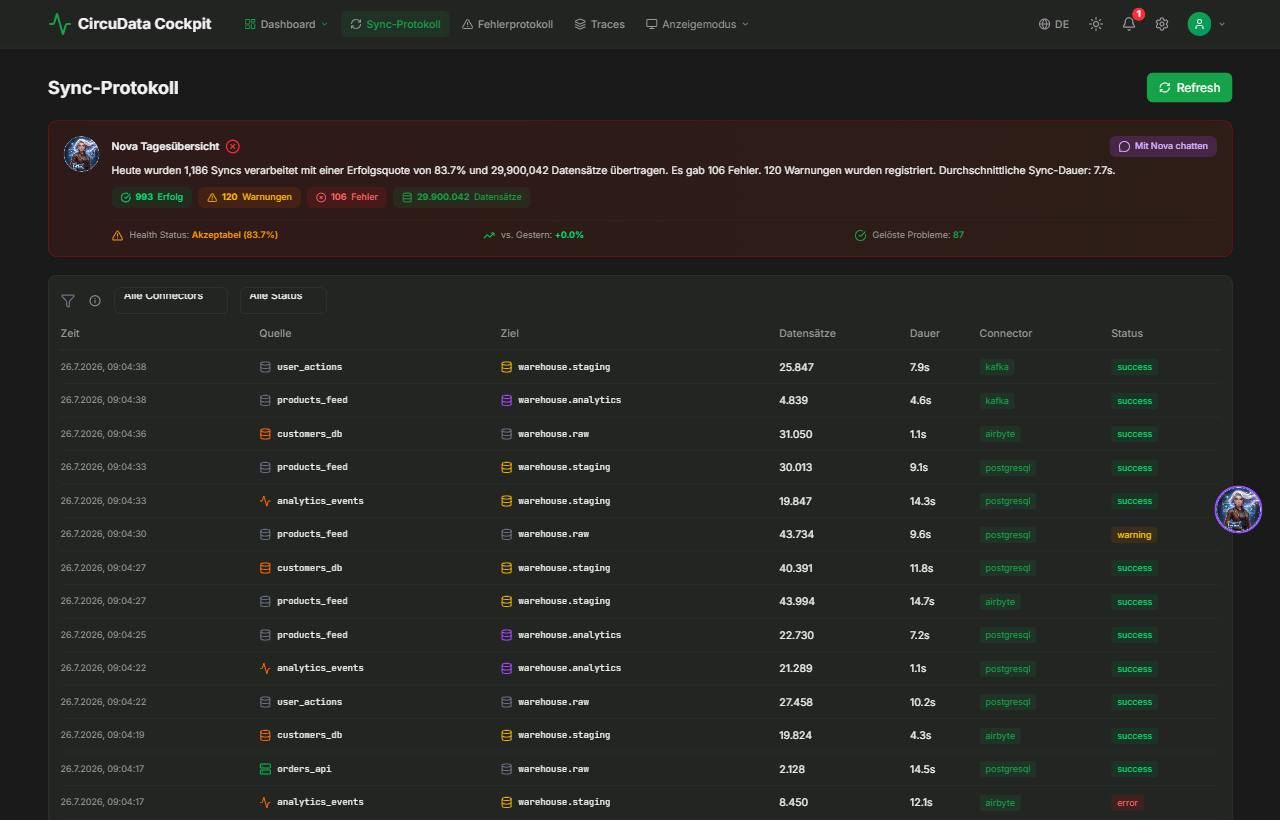
AI analyst Nova in the CircuData Cockpit – view from our demo system with sample data.
Find out what agents can do for you
Start with the agent potential analysis: two weeks, fixed price, three concrete use cases with a cost-benefit calculation – before you invest a single euro in implementation.
Request an agent potential analysisFrequently asked questions about AI agents
What does an AI agent cost?
That depends on the process. That's why we start with the agent potential analysis at a fixed price: in two weeks, you'll know which three processes have the greatest leverage and what implementation and operation cost – before you invest.
Do AI agents replace our employees?
No – they take over the routine work nobody enjoys today: retyping data, checking receipts, following up on status. Your employees keep the decisions and gain time for tasks that require judgment. In practice, that relief is exactly why teams accept the agents quickly.
What data does an AI agent see – and where is it processed?
Only what it needs for its task. Every agent gets clearly defined access rights, and on request, AI processing runs exclusively with European models or on your premises. Every action is logged and traceable.
What happens if an agent makes a mistake?
The agent doesn't clear critical steps on its own: we build in approval levels where a human confirms before anything goes out or gets posted. On top of that, every action is logged – you can trace what the agent did and why at any time.
How long does implementing an AI agent take?
The first productive agents typically go live after four to eight weeks – provided the data foundation is right. That's exactly why we check it first in the potential analysis. After that, we expand step by step: one process first, then the next ones.
Do we need a new ERP system for this?
No. Agents work within the systems you already have – ERP, CRM, email, accounting. If your system landscape consists of many isolated solutions, though, we'll tell you honestly where consolidation would multiply the agents' benefit.
How long until an AI agent is productive?
A first agent with a clearly defined task typically goes productive after a few weeks – including a test phase with human oversight. After that, we expand step by step on what proves itself.
How do we control what an AI agent does?
Every agent works with clearly defined rights, logs every action, and escalates uncertainties to a human. Critical steps – approvals, payments, terminations – always stay with your employees.
Which tasks are not suited to AI agents?
Anything that requires real judgment, responsibility, or empathy: personnel decisions, price negotiations, critical customer conversations. Agents handle the prep and follow-up work – not the decision.
What infrastructure do the agents run on?
On European infrastructure or self-hosted with you – typically built on n8n. Your data never leaves the defined boundaries, and every data flow is traceably documented.