Data integration: so every number in your business adds up
When sales, accounting and production quote different numbers, it costs you time every week – and sometimes the wrong decision. We connect your systems so everyone works from the same figures: ERP, CRM, web shop, machines. Hosted in Europe, GDPR-compliant, on your own servers if you prefer.
Request a Data Maturity AuditWhat this is costing you today
One customer sits in the system twice, under two different addresses. The month-end close waits three days for a list somebody maintains by hand. Two departments bring two revenue figures into the same meeting and spend the first ten minutes arguing about which one is right. Those are not IT problems, those are working days. And once AI enters the picture it gets more expensive: an AI assistant working on contradictory data gives answers that sound convincing and are still wrong. So we sort out the data first and talk about AI second.

Four steps to numbers you can rely on
1. Stocktake – you see where you stand
Within two weeks we look at which systems you run, which data sits where and where things break down. You get a map of your data landscape, an honest assessment and a prioritised roadmap – at a fixed price. Afterwards you decide freely whether and with whom you implement.
2. Connecting systems – without vendor dependency
We connect your systems with Airbyte, an established open-source tool with more than 600 ready-made connections: ERP (Odoo, abas, xentral), CRM (HubSpot), web shop, machines and legacy systems. Everything openly documented – you could take it over yourself at any time, or hand it to another partner.
3. One data platform everyone refers to
Your central data platform is built on PostgreSQL: every figure defined once, every change traceable, every report drawn from the same source. The state from six months ago stays available too. No more two revenue figures in the same meeting.
4. In operation – errors surface before they cause trouble
Validation rules and monitoring run automatically. If a data flow stalls or values stop making sense, the system reports it – not the customer who received the wrong invoice. And it is settled who inside your company is responsible for which data.
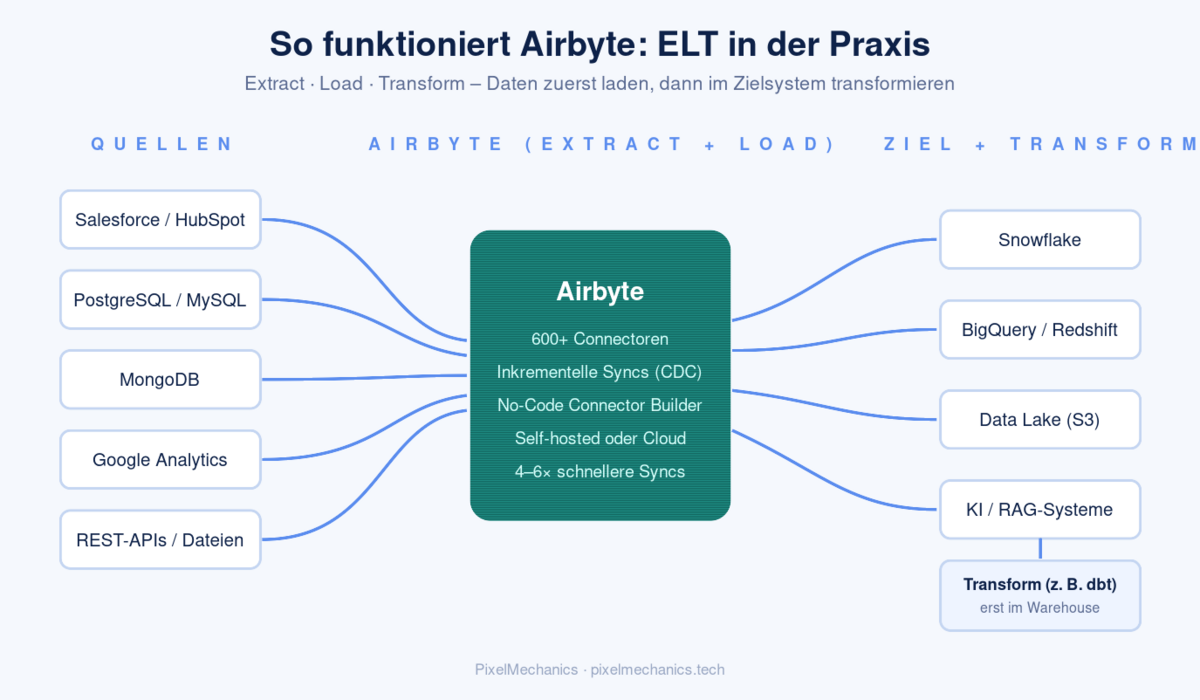
How your data flows: over 600 Airbyte connectors link sources and targets – self-hosted or in the European cloud.
Your data stays your data
We host in European data centres under the GDPR – or, if you prefer, entirely on your own servers on site. For AI analysis the rule is simple: only what you release gets processed, and you can see at any time which system accesses which data. Nothing quietly flows off to services you have never heard of.

„Every AI project is only as good as its data foundation. That's why we check your data first – and talk about agents after.“
See for yourself whether the numbers are right: the CircuData Cockpit
A data platform is only worth something once you trust it. So we do not just build it, we make it visible: the CircuData Cockpit shows you continuously which systems are connected, when data last flowed and where something is stuck. You do not have to ask anyone whether the figures are current – you can see it.
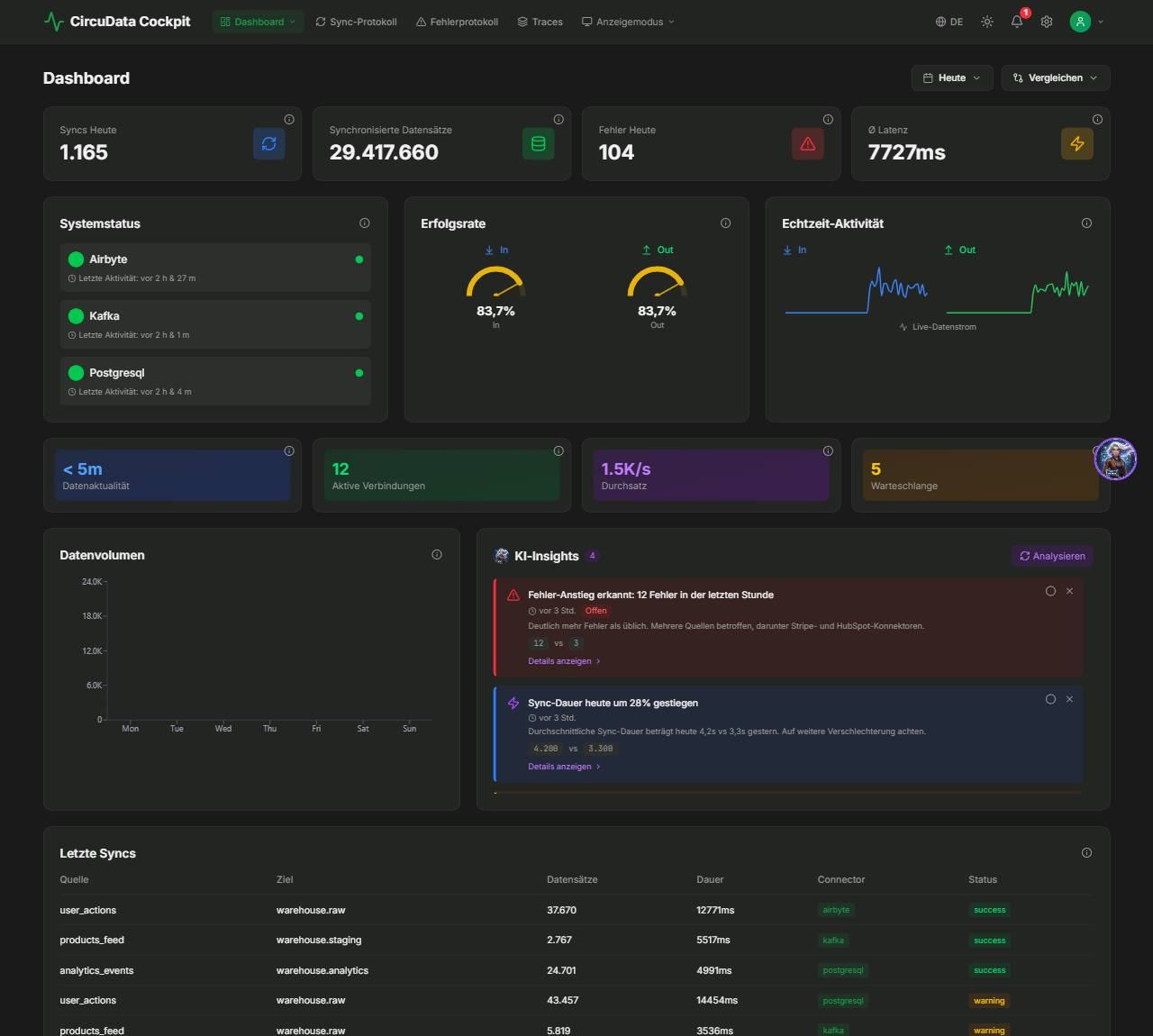
A data platform you can actually see: CircuData Cockpit – view from our demo system with sample data.
When it matters
„Thank you for finding the pipeline problem on our server – it's great to have a partner like this!“
Gerhard Bachmeier · CEO, HÖGL shoe fashion GmbH
The first step costs two weeks and a fixed price
Start with the data readiness audit: within two weeks you know where your data stands, what needs doing and what it costs – at a fixed price. Then you decide in your own time whether and how to continue. No framework contract, no upfront commitment on your side.
Request a Data Maturity AuditFrequently Asked Questions
What does data integrity actually mean?
Every piece of information exists only once, is up to date, and is consistent everywhere – in the ERP, the CRM, and reporting. Changes are traceable, and responsibilities are clearly defined. This means you can trust every number your system produces.
Which systems can be connected?
ERP systems like Odoo, abas, or xentral, CRM systems like HubSpot, web shops like Adobe Commerce and Shopify, machine and IoT data, as well as legacy Excel and database records. Over 600 ready-made Airbyte connectors cover most sources – we connect specialized systems individually.
Where is our data stored – and can this also be on-premises?
By default, we host GDPR-compliant in European data centers. If your data must not leave your premises, we run the entire data platform on-premises on your own infrastructure. In both cases, you retain full data sovereignty.
Why open source instead of a proprietary integration platform?
Airbyte and PostgreSQL are open standards: no license traps, no dependency on a single vendor, full cost control. You can switch providers or take over the platform yourself at any time – a decisive safety argument for mid-sized companies.
How long does it take to build a data platform?
The data maturity audit delivers a data map and a prioritized roadmap after two weeks. The first production data pipelines typically go live after four to eight weeks – depending on the number of systems and the quality of existing data.
What does data integration cost?
We offer the data maturity audit at a fixed price. The project costs after that depend on the number of systems to be connected – after the audit, you receive a transparent quote with clear phases and no hidden follow-up costs.
What happens if a connected system changes its interface?
Then we adjust the connection – that is part of running the platform. Because everything is built on open standards, you are not tied to one vendor's release plan. You notice such a change in the monitoring, not in a report with wrong numbers.
Do we need our own IT department for this?
No. In most of the companies we work with there is one person who knows the systems – that is enough. We run the platform, take care of monitoring and updates, and report where data was missing or arrived late. What follows from that is your decision.
How do you deal with duplicates and contradictory master data?
First we make the problem visible: which records exist twice, which fields contradict each other, which are missing. Then we agree on rules – which system is the leading one for which field. From that point on the platform enforces those rules and reports every deviation.
Can we start small and expand later?
Yes, and that is exactly what we recommend. We start with the two or three systems that hurt the most and one report that someone actually uses. Every further system is added afterwards, without rebuilding what already works.