



Anyone designing a data strategy today eventually runs into the same question: how do I reliably get data from dozens of sources – CRM, ERP, databases, marketing tools, APIs – into my data warehouse or my AI application? For years the standard answer was an expensive, proprietary tool with licensing costs that grew with every row of data. There is a better answer, and it is called Airbyte.
In this article we explain why, in our view, Airbyte is the ideal open-source middleware for data integration – from the perspective of decision-makers who care about cost, risk and data sovereignty. We look at the company behind it, the most important releases of recent months, and who Airbyte actually makes sense for.
What is Airbyte?
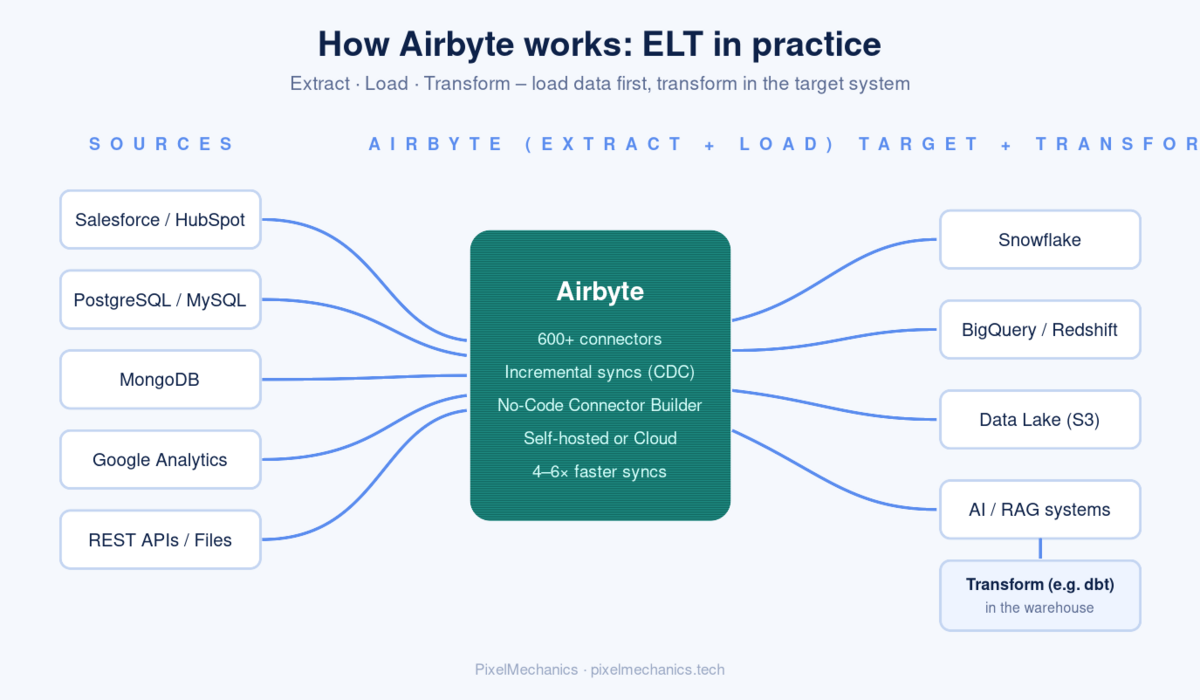
Airbyte is an open-source data integration platform that extracts data from more than 600 sources and loads it into data warehouses, data lakes, databases or AI applications. It follows the ELT principle (Extract, Load, Transform): data is first loaded into the target system and only transformed there – in contrast to classic ETL, where the transformation happens before loading.
Put simply, Airbyte is the connective tissue – the middleware – that links your scattered data silos to a central place where you can analyze, report and automate. What makes it special: the core is open source and can be self-hosted for free. If you would rather not run it yourself, you use the hosted Cloud edition. Both share the same connector catalog.
The company behind Airbyte
Airbyte was founded in 2020 by Michel Tricot and John Lafleur and went through the renowned startup accelerator Y Combinator. Tricot, now CEO, was previously Director of Engineering and Head of Integrations at LiveRamp and RideOS – so he knows the data integration problem first-hand. That experience shaped Airbyte's founding idea: data integration should be an open commons, not the expensive secret of a few vendors.
The concept also convinced investors. Across several rounds, Airbyte raised a total of roughly 181 million US dollars, including from well-known backers such as Benchmark, Accel and Coatue. A Series A of 26 million US dollars was followed by a Series B of 150 million US dollars, valuing the company at around 1.5 billion US dollars. This financial footing matters to decision-makers: it speaks to the longevity of a project you are basing your data infrastructure on.
Its adoption is impressive, too. According to the company, more than 7,000 active companies sync data through the platform every day, there are over 170,000 deployments worldwide, and more than two petabytes of data are moved every month. Airbyte is also backed by an active open-source community with hundreds of contributors – an ecosystem that continuously advances the platform.
Why Airbyte is the ideal open-source middleware
Open source alone is not an argument. What matters is the business value it delivers. From our consulting practice at PixelMechanics, five points in particular set Airbyte apart from proprietary alternatives.
1. No vendor lock-in
The most important strategic advantage: you don't become dependent on a single vendor. The Airbyte core is open source and can run on your own infrastructure. If a vendor's pricing model, roadmap or ownership changes, you are not trapped. Your pipelines, your connectors and your data belong to you. For a component embedded this deeply in your data infrastructure, that independence is worth a great deal.
2. The largest connector catalog in the industry
Airbyte offers more than 600 pre-built connectors – by its own account the largest catalog on the market. That covers practically everything a typical company uses, from Salesforce, HubSpot and Google Analytics through PostgreSQL, MySQL and MongoDB to data warehouses like Snowflake, BigQuery and Redshift. If a source is missing, you can build it yourself with the No-Code Connector Builder without deep programming skills. More than 2,000 such custom connectors are already in use. In other words: you don't wait months for a vendor to build an integration – you build it yourself when you need it.
3. Cost control instead of unpredictable license fees
Proprietary integration tools often charge by data volume or rows – so the bill grows exactly when your business grows. With the self-hosted open-source edition of Airbyte you essentially pay only for your own infrastructure. That makes costs predictable and decouples them from raw data volume. If you value convenience, you can start with the Cloud edition and self-host later – or the other way around. Most closed systems don't offer this flexibility.
4. Data sovereignty and GDPR compliance
For companies in the German-speaking and wider European market in particular, where data is processed is decisive. Because Airbyte can run entirely within your own environment, sensitive data never leaves your infrastructure. That significantly simplifies GDPR compliance and internal governance requirements. With the newer Enterprise Flex edition, Airbyte also offers a hybrid model: a centrally managed control plane in the cloud, while the actual data processing happens in your own infrastructure – ideal for organizations with high data sovereignty and compliance demands.
5. Future-proof for AI applications
Data is the fuel of every AI initiative. Airbyte focused early on bringing structured and unstructured data into the systems that AI models and AI agents work with. That makes the platform suitable not only for classic reporting, but also as a foundation for modern AI projects – a point we look at more closely below.
Recent releases: what's new at Airbyte
Airbyte evolves quickly. The past few months brought several significant releases focused above all on speed, data sovereignty and AI.
Airbyte 2.0 (October 2025)
Version 2.0 was released on 14 October 2025 and marks a milestone in the platform's architecture. The most important new capabilities:
- Up to 4–6× faster syncs: the new sync engine moves data four to six times faster on average – while using resources more economically.
- Data Activation (generally available): data can now not only be loaded into the warehouse, but also pushed back into operational tools such as CRM, marketing or support systems. That puts insights exactly where work happens – not just in dashboards.
- Enterprise Flex: the hybrid model mentioned above, combining cloud control with your own data plane.
- Reworked Connector Builder: the interface was aligned with the underlying YAML specification, so even complex APIs can now be connected almost entirely without code.
Faster and more reliable data movement (December 2025)
In early December 2025, Airbyte followed up with concrete performance improvements. The Microsoft SQL Server connector became 84 percent faster, and syncs from MySQL to Amazon S3 rose from 23 to 110 megabytes per second – nearly a fivefold increase. These figures are not an end in themselves: faster syncs mean fresher data for decisions and lower infrastructure costs.
Airbyte 2.1 (April 2026)
With version 2.1, released on 3 April 2026, Airbyte continued down the same path. This version supports only the new Helm chart V2 architecture – an important note for anyone running Airbyte on Kubernetes who should migrate in good time. In addition, orchestrator and sidecar containers can now output structured JSON logs, which considerably simplifies integration with common log tools such as Fluent Bit, Vector or Datadog.
Airbyte and AI: from data transfer to a context layer for AI agents
One of the most interesting developments is the push toward AI. With Airbyte Agents (Agent Engine), the company offers a data and context layer that gives AI agents real-time access to business data – through open-source, type-safe connectors, managed credentials and fast search.
Concretely, this means AI assistants and agents can access and work with company data through a standardized endpoint (Model Context Protocol, MCP) – whether in Claude, ChatGPT, Cursor or your own applications. For companies that want to do more than just experiment with AI and instead connect it productively to their own data, Airbyte closes a key gap. Yesterday's data integration platform becomes tomorrow's AI infrastructure.
The Airbyte editions at a glance
Airbyte comes in several variants that address different needs. The overview below helps with orientation:
| Edition | Operation | Ideal for |
|---|---|---|
| Self-Managed Community (Open Source) | Self-hosted, free | Teams with their own infrastructure and full cost control |
| Cloud | Fully hosted by Airbyte | Teams that want to start fast without operational overhead |
| Self-Managed Enterprise | Self-hosted with enterprise features | Larger organizations with security & governance requirements |
| Enterprise Flex | Hybrid: cloud control, your own data plane | Organizations with high data sovereignty requirements |
A note on licensing: Airbyte's connectors are mostly available under the MIT license, while the platform core is under the Elastic License 2.0 (ELv2). ELv2 permits almost all common uses; what it essentially restricts is reselling Airbyte as a hosted competing service under another name. For normal enterprise use, this is irrelevant.
Who is Airbyte right for?
Airbyte is not the right choice for everyone – but it is for many. It particularly benefits:
- Growing companies that want to decouple their data costs from raw data volume from the start.
- Organizations with strict compliance requirements that must keep data within their own infrastructure.
- Teams with niche data sources for which no proprietary vendor provides a connector.
- Companies with AI ambitions that want to make their data usable as a foundation for AI applications.
If, on the other hand, you only need to connect a single standard source and want zero operational effort, a lean specialized tool may be simpler. Airbyte's strength unfolds where variety, scale and independence come together.
Conclusion
Airbyte combines the advantages of open source – independence, transparency, cost control – with the feature scope and speed of commercial platforms. With the largest connector catalog in the industry, solid funding behind it, an active community and a clear focus on data sovereignty and AI, it is in our view the most compelling open-source middleware for data integration available today.
For decision-makers, the real question is rarely "open source or not?" but "how do I keep control over cost, data and future readiness?". Airbyte answers exactly that question – which is why we regularly recommend it at PixelMechanics as the foundation of modern data architectures.
Wondering whether Airbyte fits your data strategy, or need support selecting, building and operating your data pipelines? Talk to us – we accompany you from architecture to productive operation.
Frequently asked questions about Airbyte (FAQ)
What is Airbyte in simple terms?
Airbyte is an open-source platform that automatically transfers data from more than 600 sources into a central target system such as a data warehouse or an AI application. It acts as middleware between your data silos and your analytics or AI environment.
Is Airbyte really free?
The Self-Managed Community edition of Airbyte is open source and free. You only pay for the infrastructure you run it on. In addition, there are paid Cloud and Enterprise editions with extra features and no operational overhead.
What is the difference between ETL and ELT?
With ETL (Extract, Transform, Load), data is transformed before being loaded into the target system. With ELT (Extract, Load, Transform), the approach Airbyte uses, data is loaded first and only transformed in the target system. ELT is more flexible and makes better use of the compute power of modern data warehouses.
Can Airbyte be used in a GDPR-compliant way?
Yes. Because Airbyte can run entirely within your own infrastructure, sensitive data never leaves your environment. That significantly eases GDPR compliance. With Enterprise Flex there is also a hybrid model that combines data processing in your own infrastructure with convenient cloud control.
What are the alternatives to Airbyte?
Well-known alternatives include Fivetran, Stitch and Matillion, as well as open-source tools like Meltano or Singer. Airbyte stands out above all through its largest connector catalog, its open-source model without vendor lock-in, and its strong focus on AI use cases.
About the author: Michael Rohrmüller is the founder of PixelMechanics and advises companies on digitalization, data architecture and the productive use of AI. His focus is on translating technical possibilities into measurable business value.