
“What does all of this actually cost us in the end?” We hear that question in almost every first conversation, and for the licence part Odoo can answer it refreshingly clearly. With Odoo 20, Odoo updated its pricing model in September 2026 and introduced a new, low-cost licence type for staff who only have a few tasks in the system. This article shows the current list prices from odoo.com, helps decision-makers choose between the plans, sorts out the hosting options and works through an example for a typical mid-sized company. What is binding is always the quotation at the time of ordering.
What changed in 2026
Odoo presented the new prices together with Odoo 20Odoo 20. The free use of a single app stays, the price of the Standard plan is unchanged, and the Light User adds a new licence that lets companies bring staff from the warehouse, production or field service into the system at a much lower cost. The Custom plan went up by 20 %. Odoo explains this with prices that had stayed unchanged since 2022 while inflation accumulated to 26 % over that period, and points to rising costs for AI, hosting and IT on top of that. Companies in Germany pay the euro prices.
All prices are net. That is stated explicitly in the Odoo Enterprise Subscription Agreement, section 5.3: the fees are exclusive of taxes, so VAT comes on top.
The plans at a glance
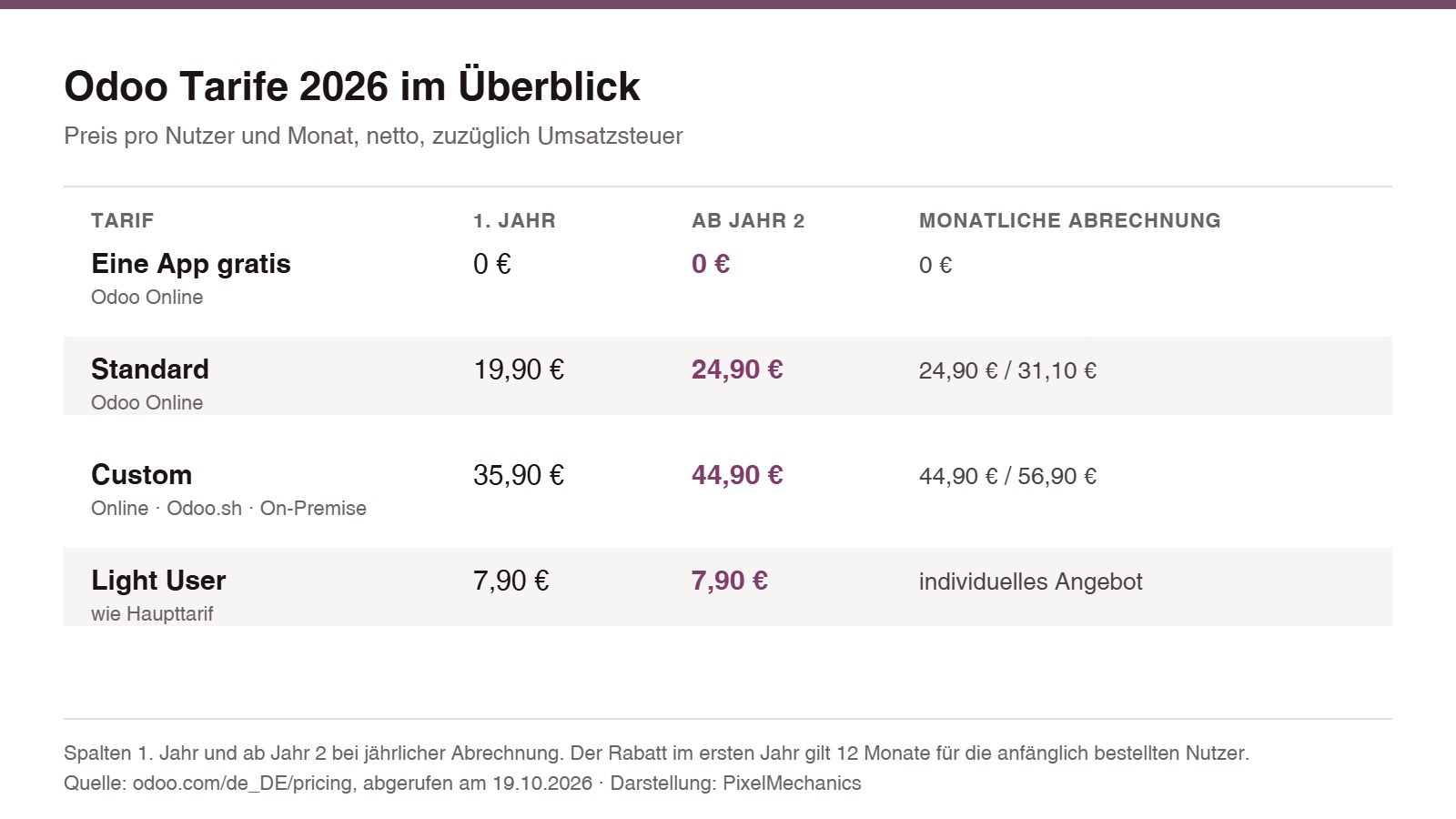
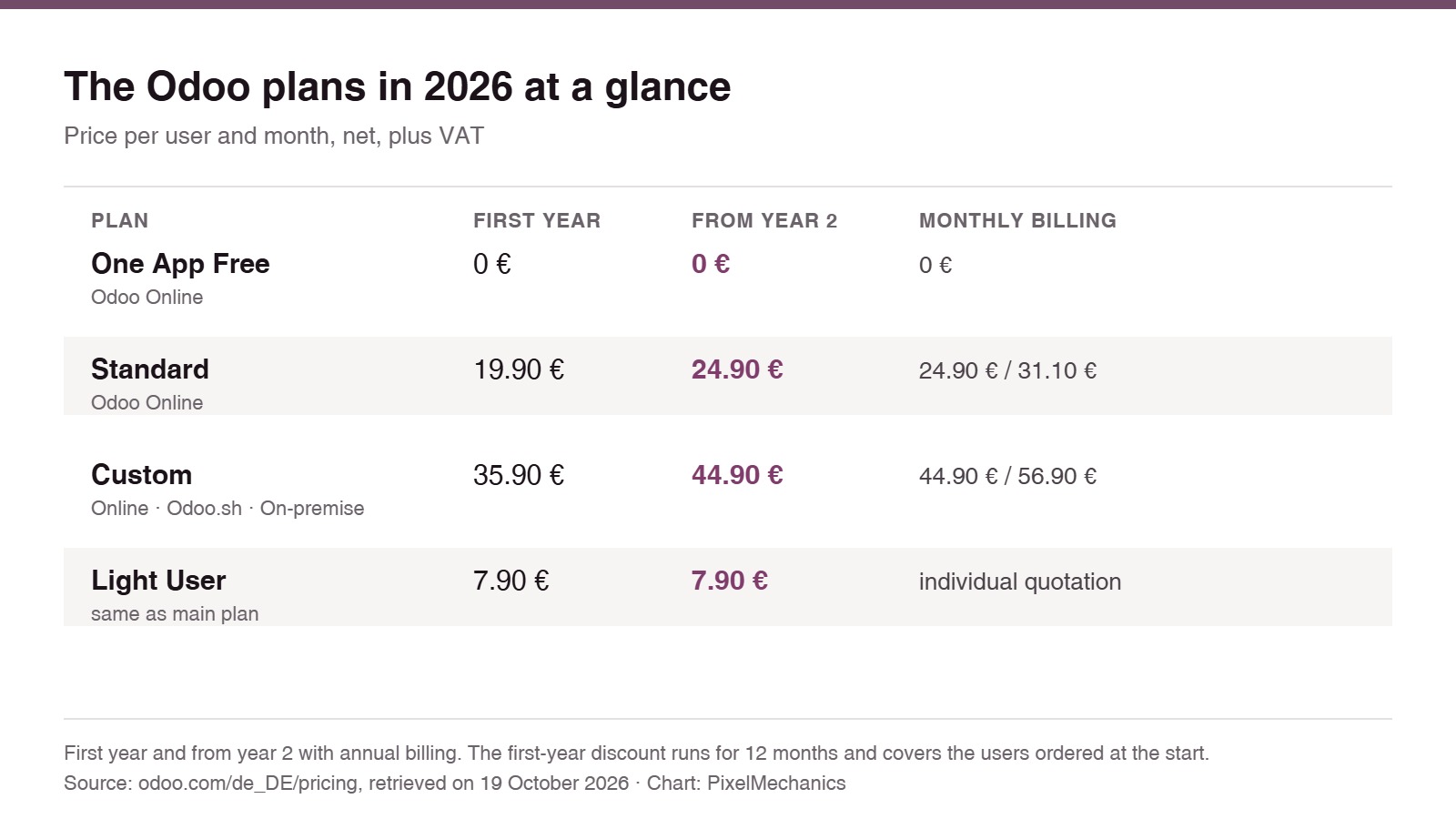
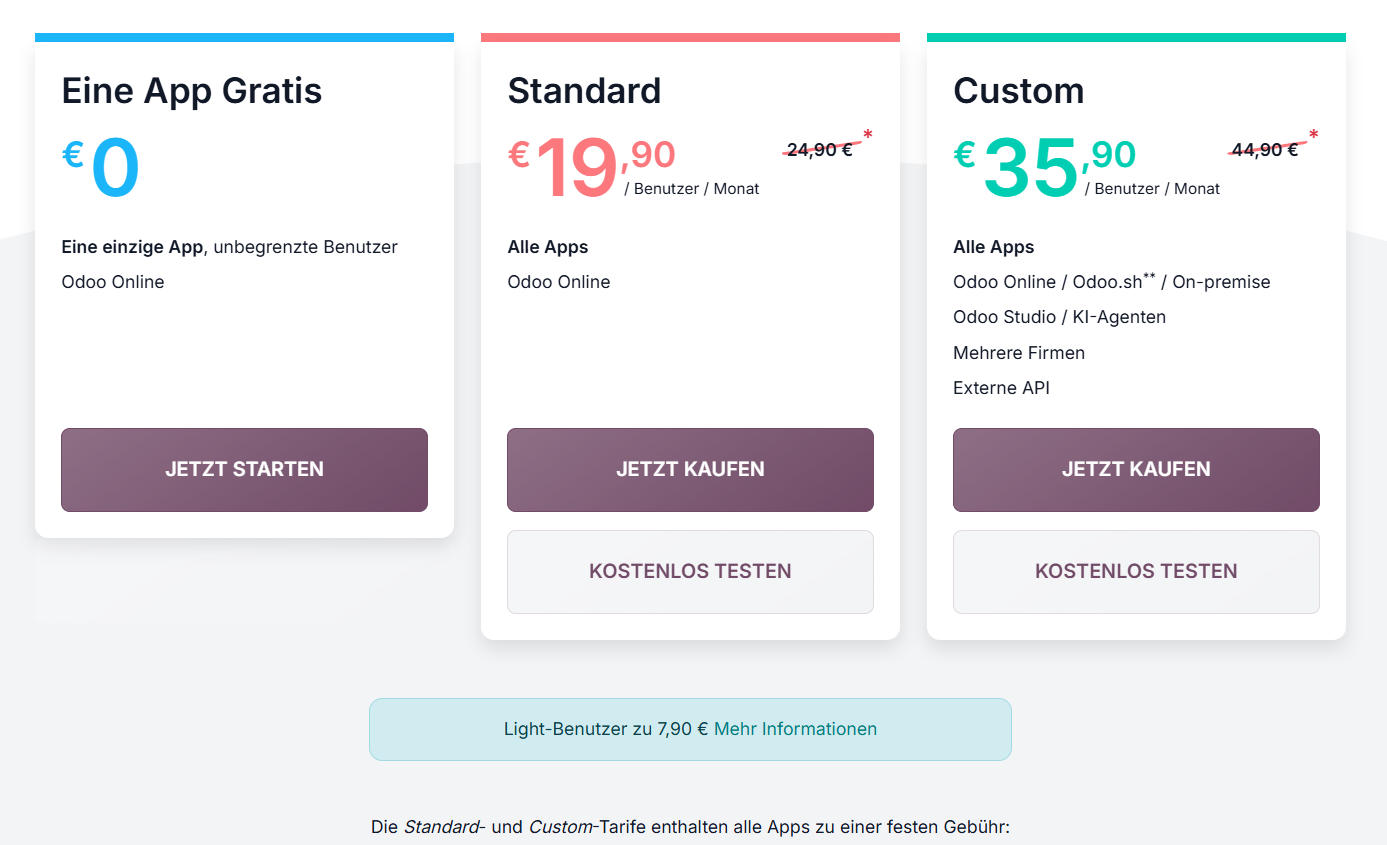
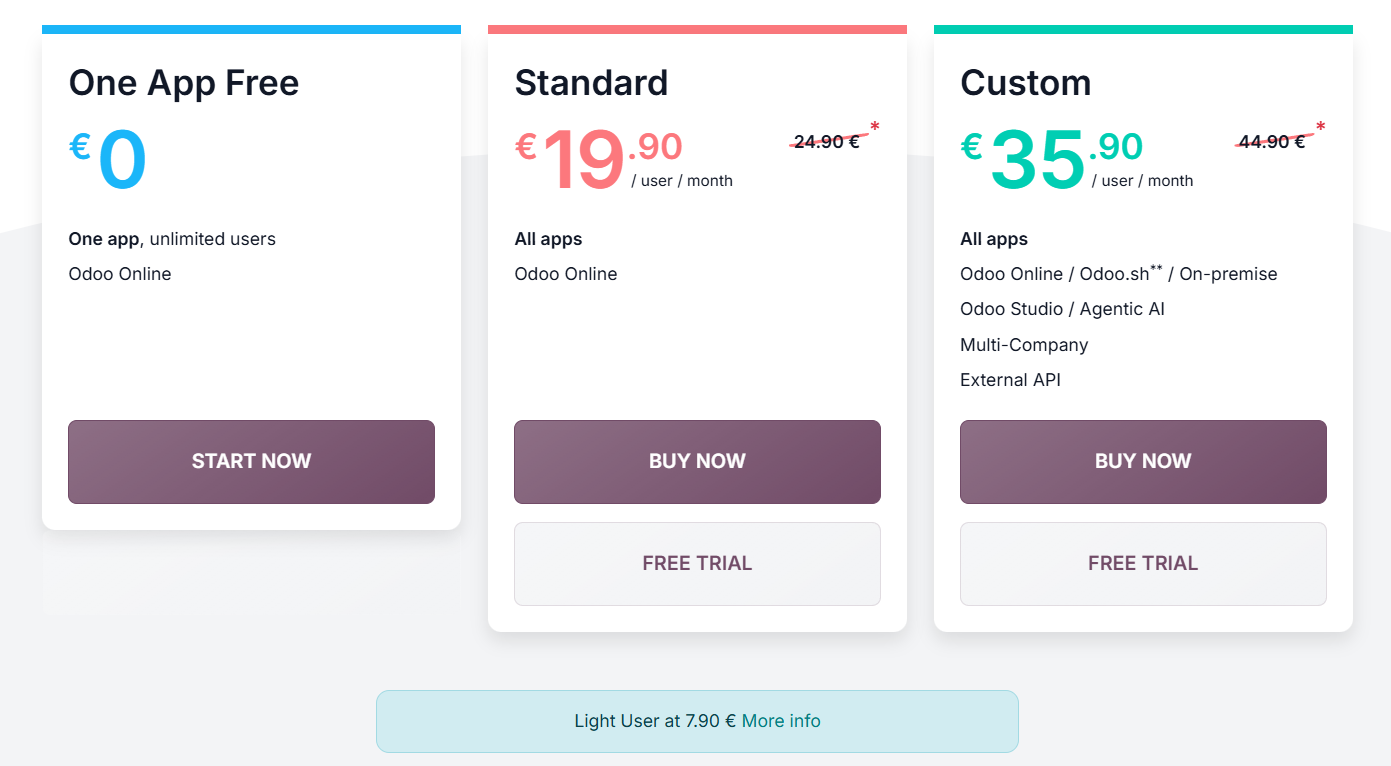
One App Free costs 0 € and allows a single app with an unlimited number of users on Odoo Online, Odoo’s own cloud. For a first step into one single area it is a good way to get to know Odoo without licence costs.
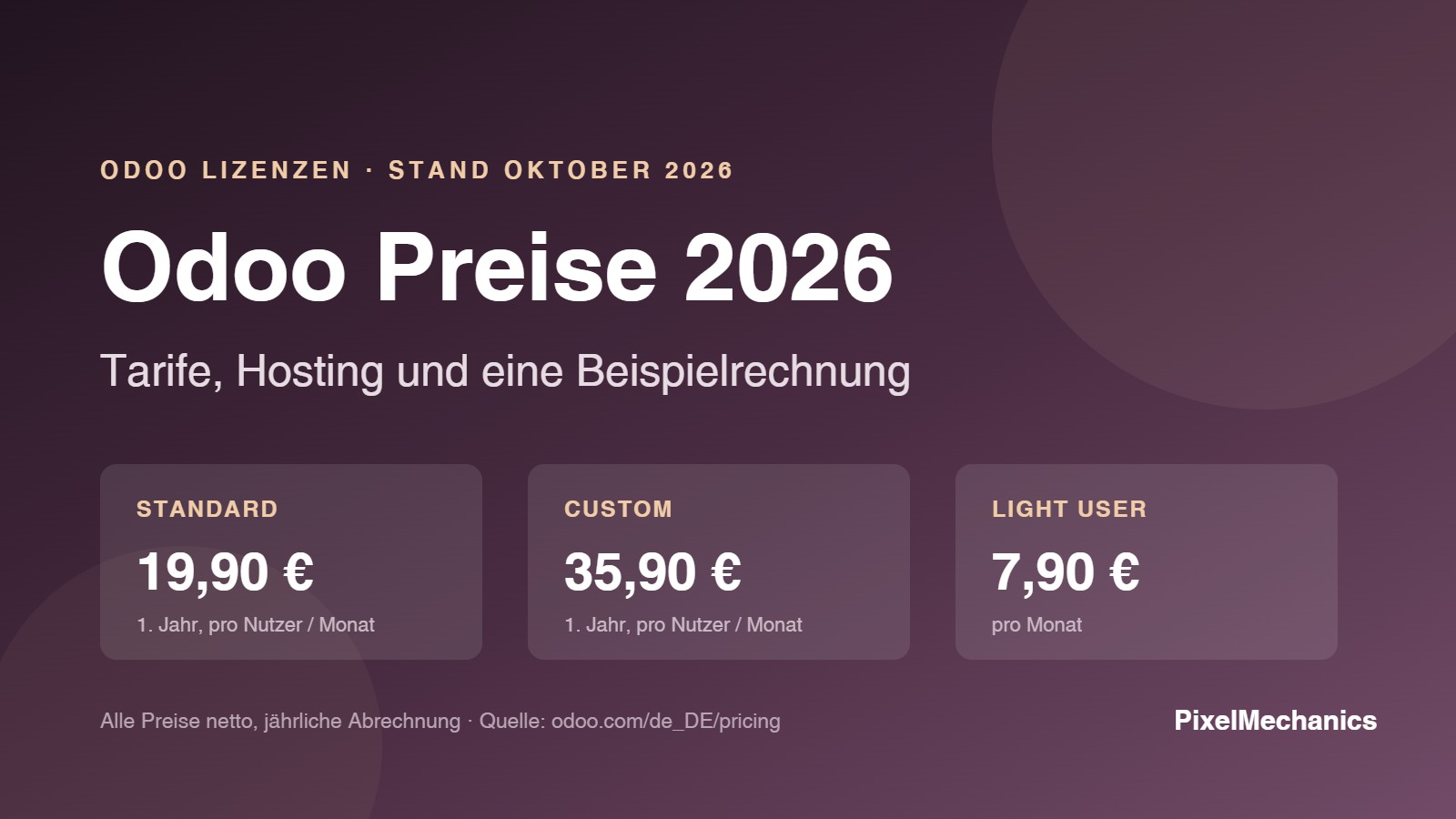
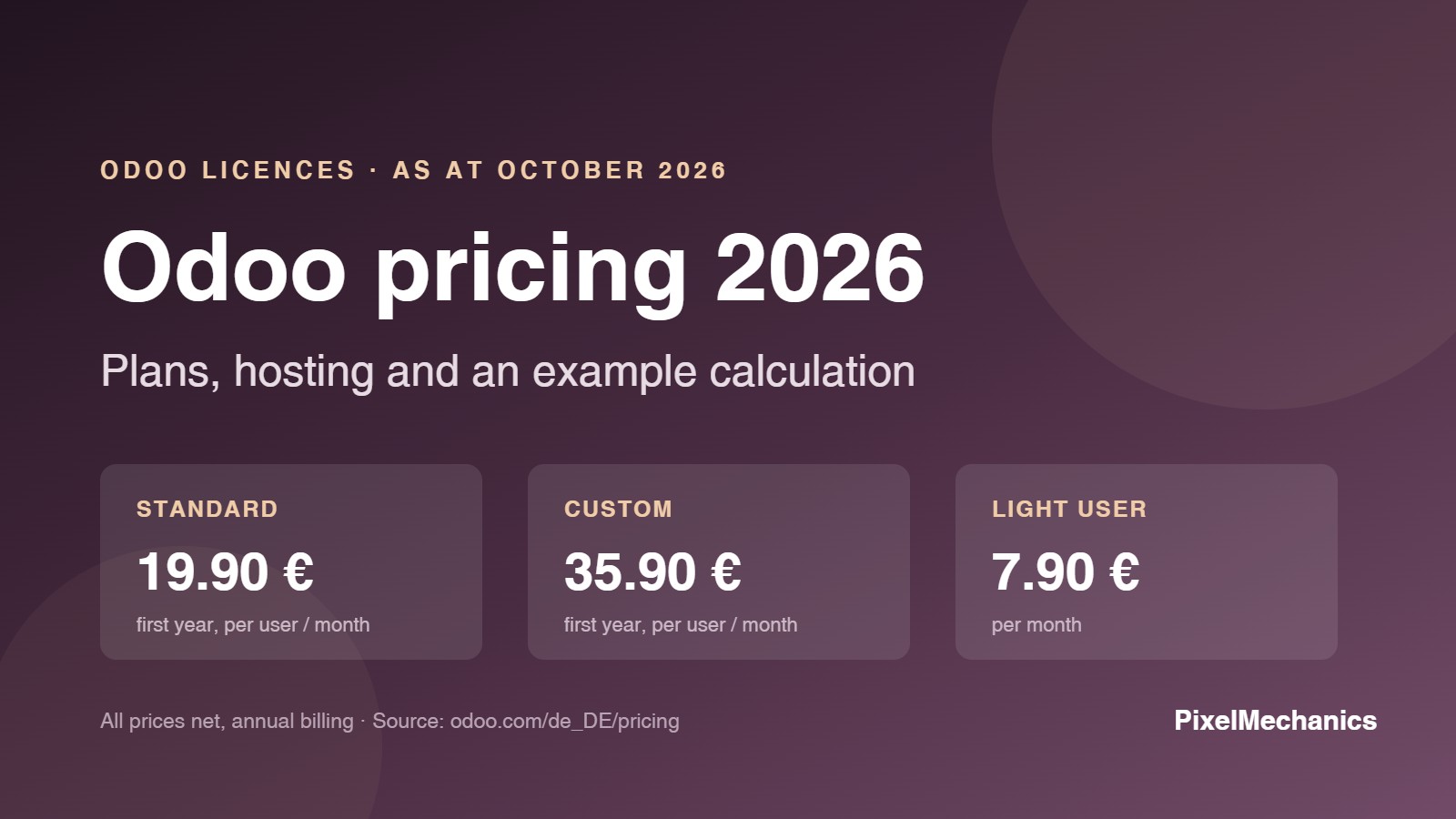
Standard starts at 19.90 € per user and month in the first year with annual billing; from the second year the list price of 24.90 € applies. With monthly billing it is 24.90 € in the first year and 31.10 € afterwards. Included are all apps on Odoo Online, from CRM through sales and accounting to inventory and projects.
Custom begins at 35.90 € in the first year with annual billing and sits at 44.90 € afterwards; with monthly billing it is 44.90 € first and 56.90 € later. In return, companies also get the choice between Odoo.sh, Odoo’s hosting platform for custom modules, and running the system on their own servers (on-premise). On top of that come Odoo Studio for changes without programming, AI agents that prepare tasks in Odoo, several companies in one database and the external API for exchanging data with other systems.
Light Users are listed at 7.90 € per month on the pricing page. This licence is meant for staff who use Odoo only for their own tasks. Odoo grants it through a conversation with an Odoo advisor and an individual quotation, so that the number and the scope can be matched precisely to how the company works.
The first-year discount runs for 12 months and applies to the users ordered at the start. For companies that is a good reason to plan the number of users realistically from the beginning and to make the entry cheaper. Anyone who budgets the list price from the second year right away starts with a figure that still holds beyond the first twelve months.
What the price includes – and what it does not
Odoo puts a lot into the licence price: according to the pricing page all plans cover unlimited support, hosting on Odoo Online and maintenance, plus backups and upgrades at no extra cost. For companies on Odoo Online that removes many items which are charged separately under other operating models.
A complete calculation includes a few further items that deliberately sit outside the licence price: hosting on Odoo.sh for custom development, the implementation itself, credits for in-app purchases such as SMS or AI scans of incoming invoices, and the maintenance of custom code. Anyone running custom modules should also know that the agreement provides for a recurring fee per 100 lines of code; the amount is set in the contract. For the implementation, our Odoo implementation pageOdoo implementation page names an entry level from 14,900 € and a usual range of 39,000 to 49,000 €.
One item is easy to overlook: if the database stays on a version Odoo no longer covers, the agreement provides for a 25 % surcharge on the annual price once per year – at the earliest six months after a new major version appears. Regular upgrades are therefore not only a technical decision but a commercial one.
Hosting: which plan fits which setup?
Choosing the hosting is one of the most important decisions, because it determines the plan at the same time. Companies working on Odoo Online already have hosting inside the licence price. Anyone who wants to run custom modules or keep Odoo in their own data centre finds the basis for that in the Custom plan.
| Hosting | Possible plan | Note |
|---|---|---|
| Odoo Online (SaaS) | Standard or Custom | Hosting included in the licence price |
| Odoo.sh (PaaS) | Custom only | Hosting is charged separately from the licence |
| On-premise | Custom only | Servers, operation and updates are the company’s responsibility |
According to the pricing page the Odoo.sh costs are charged separately and are not part of the licence price. For companies already working on Odoo.sh or on their own server that is a sound basis for planning: keeping licence and hosting as two separate budget items shows at a glance what the money is spent on.
Standard or Custom?
The Standard plan is usually enough when a company works with one company in one database, when the Odoo appsOdoo apps cover the processes without custom programming, when cloud operation on Odoo Online suits the IT setup and when no other systems need to be connected through the external API. For many mid-sized companies that is a lean and very economical route.
The Custom plan plays to its strengths as soon as at least one of these points applies:
- Fields, forms or workflows are to be adjusted with Odoo Studio.
- Several companies are to run in one database.
- A shop, machines or analytics tools need to reach Odoo through the external API.
- Odoo is to run on Odoo.sh or in the company’s own data centre.
For the IT lead it pays off to settle Studio, the API and the assignment of Light Users early in the project, because this is exactly where the biggest lever for a good price-performance ratio sits.
How companies make the most of the Light User
The Light User is the new lever with which companies can bring their licence costs down noticeably. Odoo defines it twice on the pricing page: a Light User is any active user account flagged as a Light User in the software – and, in addition, every active employee record from the HR apps that is not linked to an active non-portal user account.
The functional scope is clearly drawn. As a user there are “My Time Off”, “My Expenses”, “My Appraisals”, “My Attendances”, “My Referrals” and “My Planning”, plus Field Service, the barcode operator for inventory and read access to Knowledge. As an employee it is possible to retrieve payslips, use the point of sale and work on the shop floor. Anyone who goes beyond that and creates, views or edits documents in the backend is a full paying user by Odoo’s definition.
That produces a very concrete lever: archiving former employees and placeholder records consistently makes sure that only the people who actually use Odoo end up in the calculation. And because Odoo grants the Light User through an individual quotation, it is worth settling the number and the scope in the conversation with the Odoo advisor before planning firmly with it.
What this means for existing and new customers
New customers start on the new list prices and benefit in the first year from the discount on the users ordered at the start. For existing customers the transition is easy to plan, because changes usually only take effect at renewal. Section 5.2 of the Odoo agreement provides that charges below the current list price can rise by up to 7 % per year of the previous term at renewal. Companies on a cheaper legacy price therefore approach the list price step by step and can map that development in their budget early.
Anyone adding users during a running term should know section 5.1: for additional users and Light Users the list price applicable at that moment applies, for the remainder of the term. The first-year discount cannot be extended to new users afterwards – another argument for setting the number of users realistically from the start.
Example calculation for 20 users
The calculation uses the list prices with annual billing, net plus VAT and without implementation, Odoo.sh hosting and in-app credits.
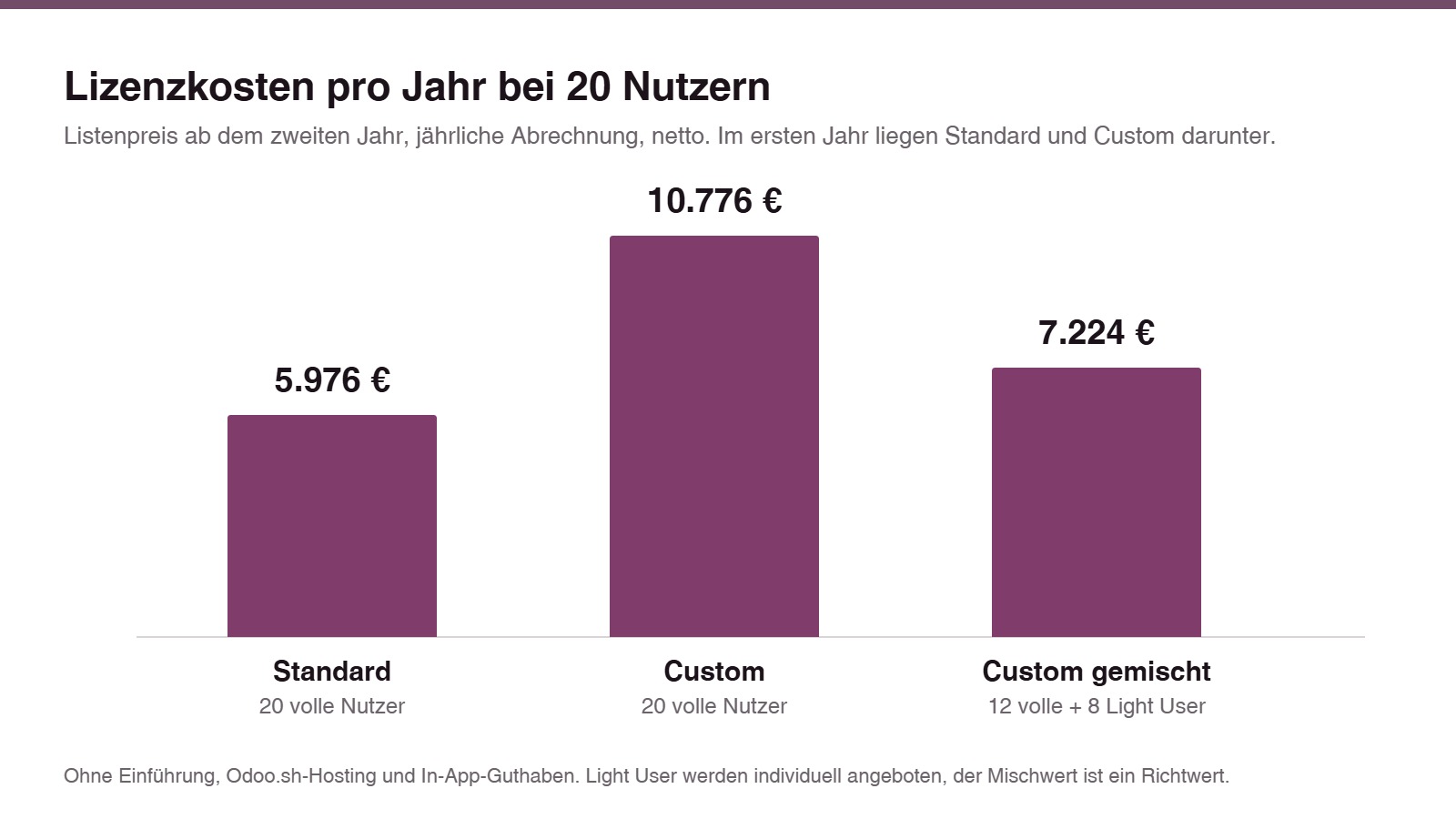
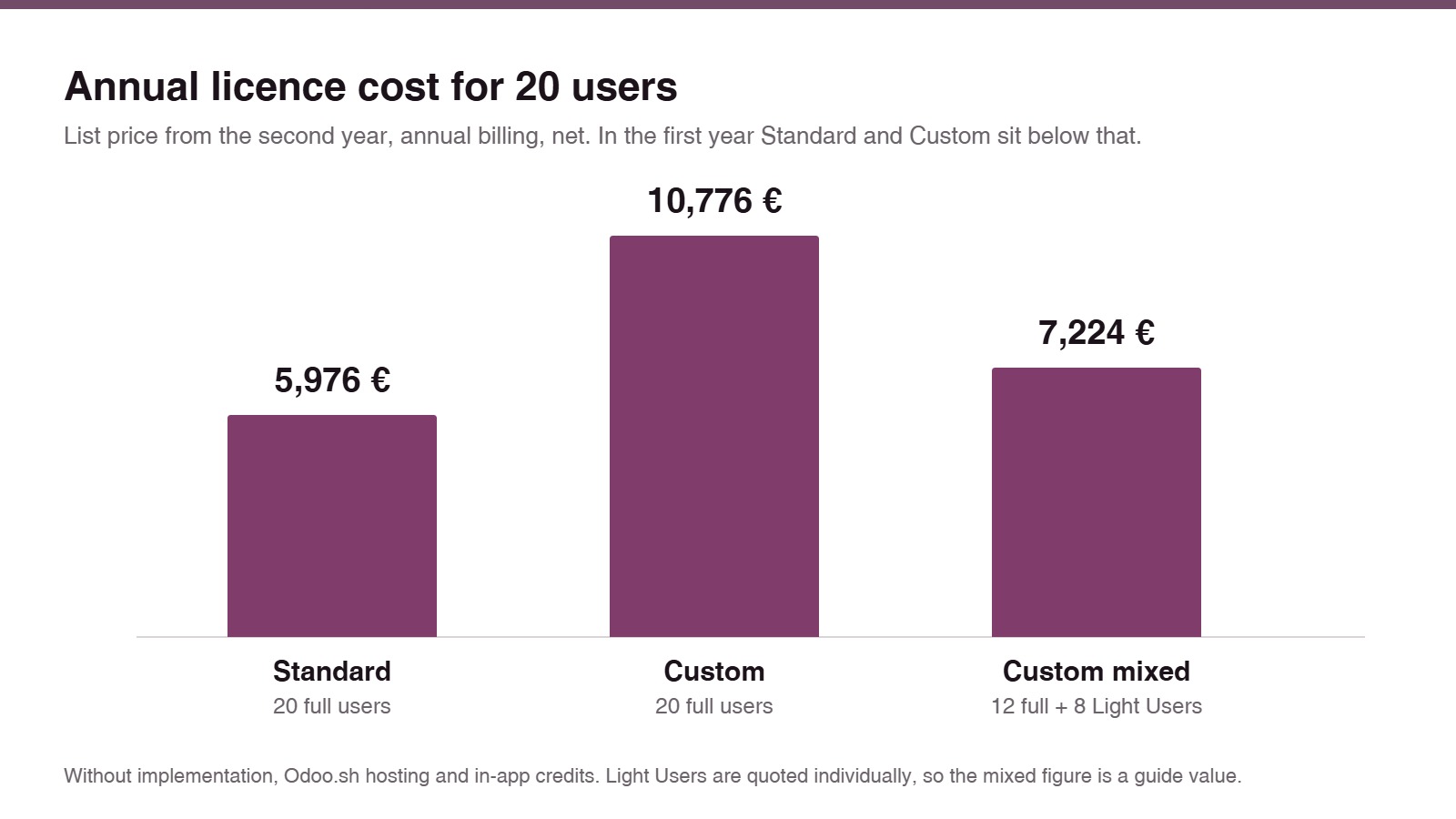
With Standard a company with 20 users pays 20 × 19.90 € × 12 = 4,776 € in the first year and 20 × 24.90 € × 12 = 5,976 € from the second year. With Custom it is 20 × 35.90 € × 12 = 8,616 € in the first year and 20 × 44.90 € × 12 = 10,776 € from the second year. What is particularly interesting is the Custom variant with 12 full users and 8 Light Users who mainly record times and absences: at list price that comes to 6,465.60 € plus 758.40 €, together 7,224 € a year and therefore a good 3,500 € less than with 20 full Custom users. Because Light Users are quoted individually, this is a guide value.
For financial planning the calculation shows how well Odoo can be budgeted: anyone who plans the move from the entry price to the list price after the first year right away has a budget that stays stable across the whole term. To put it in perspective in the budget round: a Standard user costs 298.80 € net per year at list price, which is around 82 cents a day, and a Custom user comes to about 1.48 € a day.
Five routes to the best price-performance ratio
- Review the users: it starts with the question of who really needs full access. Staff who only record times, absences or expenses may qualify as Light Users.
- Clean up the rights: removing access rights nobody needs any more makes it possible to assign the user types cleanly.
- Archive employee records: active records without a user account count as Light Users according to Odoo, so archiving former employees pays off directly.
- Check Standard as an option: companies that need neither Studio nor the API, several companies or their own hosting save 20 € per user and month against Custom at list price.
- Prepare the renewal: planning the licence review before the next contract renewal means going into the conversation with Odoo with clean user numbers and a clear basis.
Conclusion
Even after the 2026 adjustment Odoo stays transparent and easy to budget: a fixed net price per user, all apps included and, on Odoo Online, hosting, maintenance and upgrades in the package as well. The first-year discount makes the entry cheap, and the new Light User opens up additional room for mid-sized companies. The best price-performance ratio goes to companies that choose plan, hosting and user types deliberately and budget the list price from the second year from the outset.
For companies that want to know which plan suits them best, we offer a 30-minute conversation. In it we work through the figures together with the actual number of users, without obligation and based on your own processes. Arrange an appointmentArrange an appointment.
Sources
- Odoo: Pricing, odoo.com/de_DE/pricing (retrieved on 19 October 2026)
- Odoo: Enterprise Subscription Agreement, sections 5.1, 5.2 and 5.3, odoo.com/documentation/latest/legal/terms/enterprise.html (retrieved on 19 October 2026)
- Odoo Blog: Odoo takes stock of 2026, to the article on odoo.com (retrieved on 19 October 2026)
- PixelMechanics: Odoo implementationOdoo implementation
Frequently asked questions about Odoo pricing in 2026
What does Odoo cost per user in 2026?
The Standard plan costs 24.90 € per user and month with annual billing, and 19.90 € in the first year. The Custom plan costs 44.90 €, and 35.90 € in the first year, each net. Light Users are listed at 7.90 € per month on the pricing page.
What is an Odoo Light User?
A Light User is a low-cost licence for staff who use Odoo only for their own tasks. A Light User is any active user account flagged as such in Odoo, as well as every active employee record from the HR apps without a linked non-portal user account. Odoo grants the licence through an individual quotation.
Which functions may a Light User use?
According to the Odoo pricing page: “My Time Off”, “My Expenses”, “My Appraisals”, “My Attendances”, “My Referrals”, “My Planning”, Field Service, the barcode operator for inventory and read access to Knowledge. As an employee, payslips, point of sale and shop floor are added.
Which plan is needed for Odoo.sh or your own server?
Odoo.sh and on-premise are possible in the Custom plan. The Odoo.sh hosting costs are charged separately from the licence.
Do Odoo prices include VAT?
No, the prices are net and VAT comes on top. That is how it is stated in the Odoo Enterprise Subscription Agreement, section 5.3.
Do prices change immediately for existing contracts?
Usually not, only at renewal. According to section 5.2 of the Odoo agreement, charges below the list price can then rise by up to 7 % per year of the previous term, which makes the adjustment easy to plan.
What does it cost to add users during the term?
For additional users and Light Users, section 5.1 of the agreement applies the list price applicable at that moment, calculated for the remainder of the term. The first-year discount only applies to the users ordered at the start.
Do employees without a user account count as users?
Yes. An active employee record without an assigned user account is a paying user according to Odoo and is counted as a Light User. Former employees and placeholders should therefore be archived consistently.
What does Odoo cost if the database stays on an old version?
The agreement provides for a 25 % surcharge on the annual price once per year if the database runs on a version that is no longer covered – at the earliest six months after a new major version appears.
What does the implementation cost on top of the licence?
The implementation is not part of the licence price. PixelMechanics names an entry level from 14,900 € and a usual range of 39,000 to 49,000 € for an Odoo implementation, depending on scope, data migration and the number of areas.